Copper peptide hair growth: GHK-Cu and its relatives
The most useful hair-count trial contains GHK and another active ingredient. The human-follicle paper contains a different copper peptide.
ALAVAX in 45 men
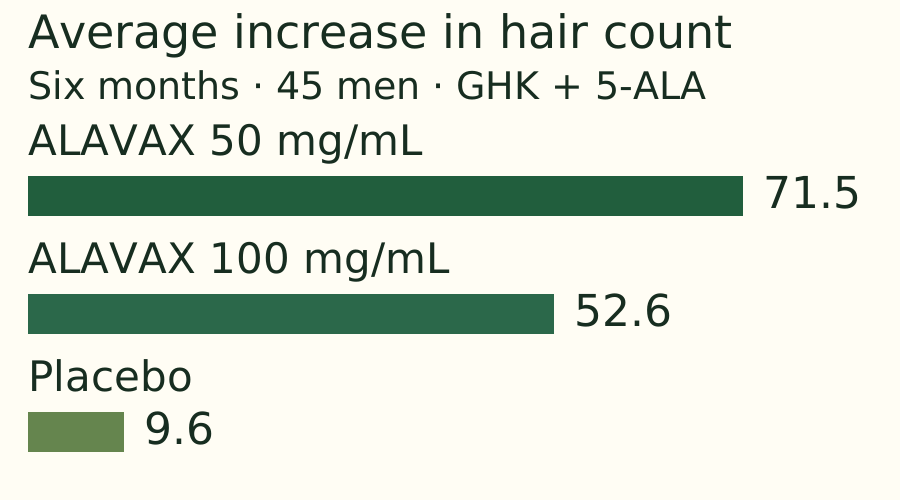
The six-month ALAVAX trial enrolled 45 men with androgenetic alopecia, the common male-pattern form of hair loss. It tested a complex of 5-aminolevulinic acid and GHK. At 100 mg/mL, the mean hair-count increase was 52.6; at 50 mg/mL, it was 71.5. Placebo increased by 9.6. The paper reported p<0.05 and no adverse events in any group.
The larger average gain at the lower concentration is the awkward result I appreciate most. It makes any casual ‘more means better’ explanation difficult. More fundamentally, the intervention was a GHK-containing complex with another active ingredient. The trial establishes a result for that preparation, with the separate contribution of GHK still unresolved.
Does copper peptide regrow hair? This trial supplies a controlled human signal for the combination. Pure GHK-Cu by itself would need its own trial. The six-month observation period also leaves shorter timelines for pure GHK-Cu without validation in this record.
Copper peptides in mice and cultured follicles
The early C3H mouse study found hair-follicle stimulation with peptide-copper complexes. It supplies animal evidence for the line of investigation. A separate human follicle and dermal-papilla experiment tested AHK-Cu, the alanyl relative of GHK-Cu, using follicles outside the body and cultured cells. It reported follicle elongation, cell proliferation and reduced apoptosis, the process of programmed cell death.
The initial letter changes the peptide. I file AHK-Cu separately even if its findings are less interesting; here the distinction saves an intriguing result from being assigned to the wrong compound.
The tissue-remodelling literature discusses support for follicle cells and blood-vessel signals. The studies cited here do not establish DHT blockade as the explanation for copper-peptide hair findings. The human combination trial and the cultured AHK-Cu follicles answer different questions.
Copper peptide side effects
The absence of reported adverse events in the 45-man scalp trial is reassuring within that trial's size, duration and preparation. It has limited reach into long-term safety, other formulations or injections.
Community accounts describe both thicker-looking hair and irritation. These are anecdotal reports, not clinical evidence; people often describe several products used together. The mixture of impressions yields neither a reliable effect size nor a clear cause. The effects page covers skin irritation and pigment concerns in more detail.